Hello
This is the Horiuchi Administrative Scrivener Office.
In this article, we will provide information on the “Journalist” status of residence required when dispatching correspondents, reporters, or field reporters to Japan.
Although it is generally referred to as a “correspondent visa” or “journalist visa,” the official name under Japan’s Immigration Control and Residence Management Act is the “Journalism” status of residence.
Recently, our firm handled an application for a correspondent working for a South Korean media outlet, and we directly confirmed the application procedures with the “Media” division of the Tokyo Regional Immigration Bureau and the Japanese Consulate General responsible for South Korea.
In this article, based on that information, we will focus on explaining who is eligible for the “Journalist” status of residence, the categories defined by the Foreign Journalist Registration Card, and how to apply for a Certificate of Eligibility (COE) depending on whether you have a branch office or representative office in Japan.
What Is the "Journalist" Status of Residence?
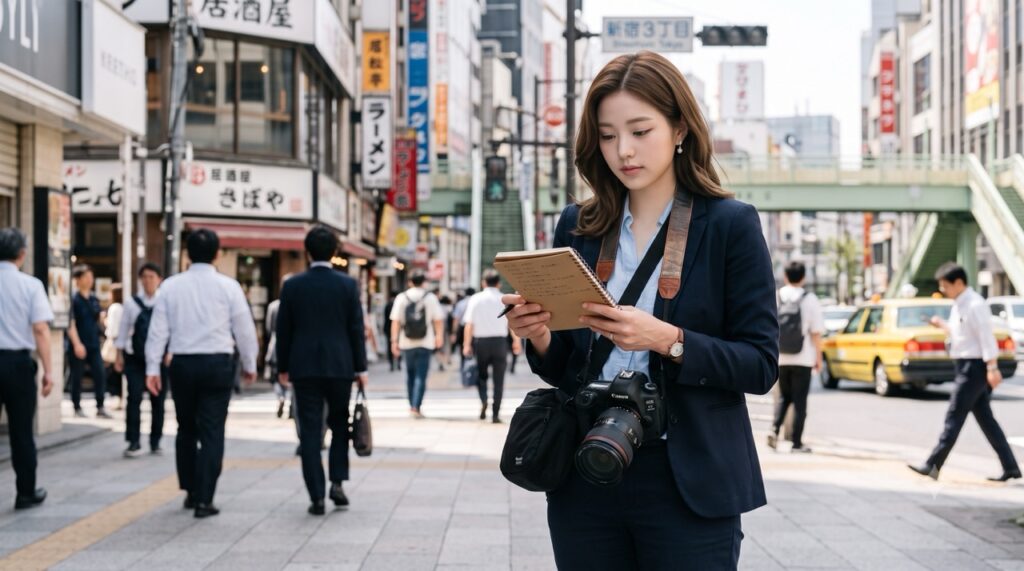
The "Journalist" status of residence is a status that allows individuals to conduct reporting and other journalistic activities in Japan based on a contract with a foreign media organization.
Typically, the following types of individuals may be eligible.
- Japan correspondents for newspapers or news agencies
- Broadcast station reporters and press officers
- A photographer covering a news story
- Reporter and Producer for News Programs
- Individuals conducting reporting activities in Japan under the direction of foreign media organizations
However, simply having the title of “correspondent” or “reporter” within a company does not automatically qualify one for the “Journalist” status of residence.
In addition, regarding corporate promotional video production, advertising shoots, and general content creation, these activities may not be recognized as “journalism” regardless of their official job titles; therefore, it is necessary to accurately verify the actual nature of the work.
What is a “foreign media organization that employs individuals who have been issued a foreign journalist registration card by a spokesperson for the Japanese Ministry of Foreign Affairs”?
When applying for the “Journalist” status of residence, a key criterion is whether the applicant’s media organization is affiliated with an agency that issues Foreign Press Registration Cards issued by the Japanese Ministry of Foreign Affairs.
A "Foreign Press Registration Card" is a registration card issued by the Japanese Ministry of Foreign Affairs to support the reporting activities of journalists affiliated with foreign media organizations based in Japan.
Although it is generally referred to as “media organizations accredited by the Ministry of Foreign Affairs,” strictly speaking, this is not a system whereby the Ministry of Foreign Affairs grants accreditation to the media organizations themselves, but rather a system under which it issues registration certificates to reporters affiliated with foreign media organizations that meet certain requirements.
When applying for the “Journalist” status of residence, if you are employed by a foreign media organization that has been issued a Foreign Journalist Registration Certificate by the Spokesperson for the Ministry of Foreign Affairs, you may fall under Category 1.
In cases falling under Category 1, since the existence of the affiliated organization and its activities as a media outlet can be verified to a certain extent through documents such as a copy of the foreign press registration card, the required documentation is simplified compared to that for other media outlets.
As a result, the review process is likely to proceed relatively smoothly.
However, possession of a Foreign Press Card does not in itself guarantee approval of a status of residence or expedited processing. The applicant’s contractual relationships, job responsibilities, and activities in Japan will be reviewed separately.
You need a COE to apply for a visa in South Korea.
It is said that in the past, there were cases in which individuals applied directly for a “Journalist” visa at the Japanese Embassy or Consulate General in South Korea without first obtaining a Certificate of Eligibility (COE).
However, when our firm recently inquired with the Tokyo Regional Immigration Bureau and the Embassy of Japan regarding the application procedures, we were informed that, as of July 2026, as a general rule, applicants must first obtain a Certificate of Eligibility (COE) from the Japanese Regional Immigration Bureau before applying for a visa at the Embassy or Consulate General of Japan in South Korea.
Therefore, as in past cases, it is not appropriate to plan the dispatch schedule on the assumption that a “press” visa will be applied for immediately within South Korea.
When planning the dispatch schedule, it is necessary to take into account the time required to prepare the COE application documents, the review period at the Japanese Immigration Bureau, and the visa review period at Japanese diplomatic missions in South Korea.
Verification Body
- The department in charge of the "Journalist" status of residence at the Tokyo Regional Immigration Bureau
- Consular Section, Embassy of Japan in South Korea
The application process varies depending on whether the company has branch offices or representative offices in Japan.
When applying for a Certificate of Eligibility (COE) under the “Journalist” status of residence, it is important to determine whether the foreign media organization has established a branch office, subsidiary, or representative office in Japan.
If the applicant has a branch office or representative office in Japan, they can proceed with the COE application while remaining in South Korea through staff at their Japanese office or other locations.
In other words, the Japanese authorities can process the application without the applicant having to travel to Japan specifically to apply for a Certificate of Eligibility (COE).
On the other hand, if a company does not have a branch office, subsidiary, or representative office in Japan, there may be no eligible individuals who can file a COE application in Japan.
Upon confirmation with the “Media Relations” officer at the Tokyo Regional Immigration Bureau, our office was informed that in such cases, the applicant may need to enter Japan on a short-term stay visa and then apply for a Certificate of Eligibility (COE) in person.
The general procedure in this case is as follows:
Enter Japan on a short-term visa → Apply for a Certificate of Eligibility (COE) while in Japan → Depart for South Korea after submitting the application → Receive the COE → Apply for a “Journalist” visa at a Japanese diplomatic mission in South Korea → Re-enter Japan after the visa is issued
Therefore, overseas news organizations that do not have a bureau or office in Japan must plan the entire application process, including not only the application documents but also the applicant’s itinerary for their visit to Japan.
Furthermore, even when an administrative scrivener acts as an application agent, the administrative scrivener does not become the applicant for an independent COE.
Since this system involves an administrative scrivener submitting application documents on behalf of the applicant—who is legally eligible to apply—or a representative of the host organization in Japan, it is first necessary to confirm whether there is a party in Japan that can serve as the applicant.
summary
The official name of the correspondent visa in Japan is the “Journalist” status of residence.
When processing applications, decisions are not based solely on the title of “correspondent”; instead, a comprehensive review is conducted that takes into account whether the applicant’s organization qualifies as a news media outlet, the contractual relationship between the applicant and the organization, the applicant’s actual duties, and the applicant’s reporting plans in Japan.
In addition, the scope of required documents may vary depending on whether you fall under Category 1 as defined by the Ministry of Foreign Affairs’ Foreign Correspondent Registration System.
Furthermore, the application process for the COE varies depending on whether the media organization to which you belong has a bureau or office in Japan.
In particular, for media organizations that do not have a base of operations in Japan, the applicant may need to enter Japan in person to apply for a Certificate of Eligibility (COE); therefore, if the date of deployment has been set, it is important to allow sufficient time for preparation.
When applying for the “Journalist” status of residence, the required procedures and documents vary depending on the type of organization you belong to and your plans for activities in Japan.
At the Horiuchi Administrative Scrivener Office, after verifying the applicant’s background, the organizational structure of the media outlet to which they belong, and their plans for their assignment to Japan, we evaluate the most appropriate application method and provide guidance accordingly.
If you need assistance with dispatching a correspondent to Japan or applying for a "Journalist" residence status, please feel free to contact us.
Horiuchi Gyoseishoshi Lawyer Office

Horiuchi Gyoseishoshi Lawyer Office (Shinjuku, Tokyo)
Attn: Gyoseishoshi Scrivener Yukiko Horiuchi
Affiliation: Tokyo Gyoseishoshi Lawyers Association, Shinjuku Branch
Tokyo Immigration and Residency Management Bureau, Application Agency Gyoseishoshi Scrivener
Member of Foreign Employment Support Organization (FESO)
▶ See our office introduction page
Access:
1 minute walk from Higashi-Shinjuku Station on the Tokyo Metro Fukutoshin Line
1 minute walk from Higashi-Shinjuku Station on the Toei Oedo Line
12-minute walk from Seibu Shinjuku Station on the Seibu Shinjuku Line
8-minute walk from Shin-Okubo Station on the JR Yamanote Line
15-minute walk from Shinjuku Station on the JR Yamanote Line
12-minute walk from Okubo Station on the JR Chuo and Sobu Lines
堀内行政書士事務所-300x189.png)