What Is the Entertainer Visa? Inviting K-POP and Overseas Artists | When It Is Required for Performances, Fan Meetings, and Filming, and the Procedures [2026]
 Yukiko Horiuchi
Hello. I’m Yukiko Horiuchi, a certified administrative scrivener at the Horiuchi Administrative Scrivener Office.
When inviting Korean artists to Japan, the first question that comes up is "Does this event require a visa?" The answer can differ for concerts, fan meetings, TV appearances, and commercial shoots. Once the performance date is set, there is not much time to prepare.
In this article, for Japanese event companies, promoters, and production companies inviting Korean artists, as well as Korean talent agencies, let's look at how to determine whether an Entertainer visa is needed, how staff are treated, the schedule, required documents, and fees.
Three key points of this article
- Performing for audiences in Japan or engaging in entertainment activities such as commercials, programs, or commercial shoots generally requires the status of residence "Entertainer."
- Staff such as managers and hair and makeup artists who work on site in Japan should, as a rule, also apply for "Entertainer" together with the performers. The decision may differ depending on the nature of their work.
- We recommend requesting our servicesat least 40 days beforethe performance date. Preparing the performance contract, venue information (number of seats and whether food and drinks are served at the seats), and a roster of everyone coming to Japan in advance will make the process go smoothly.
1. What is the Entertainer visa? Eligible activities and categories
The Entertainer visa refers to the status of residence "Entertainer." It is a status of residence for foreign nationals who perform in theatrical, entertainment, musical, sports, or other shows, or engage in other entertainment activities in Japan. Actors, singers, dancers, professional athletes, and others are eligible. Commercial photo shoots for models fall under Category 3.
The period of stay is 3 years, 1 year, 6 months, 3 months, or 30 days. For short-term performances and events, the period is set according to the schedule.
On August 1, 2023, the criteria for Entertainer (the Ministerial Ordinance on Landing Criteria) were revised. The current criteria are divided as follows according to the nature of the activity.
| classification | Main activities | Main examples |
|---|---|---|
| Category 1 | Performances of theater, singing, dance, music, etc. (hereinafter "theater, etc.") | Concerts, fan meetings, musicals (requirements are divided into (a), (b), and (c), explained in Section 3) |
| No. 2 | Shows other than theater, etc. (sports, etc.) | Professional sports matches, etc. |
| No. 3 | Entertainment activities other than shows (promotion of products or businesses, production of broadcast programs or films, commercial photography, commercial audio or video recording) | Commercial shoots, TV appearances, MV shoots, commercial model shoots, etc. |
K-POP concerts and fan meetings are mainly considered under Category 1 (theater, etc.). Commercial shoots and TV program appearances are mainly considered under Category 3. There have also been cases where advertising model shoots and photo shoots for publisher interviews were applied for under Category 3. The documents to prepare vary depending on the category.
2. Does this event require a visa? Decision table by activity
Performances for audiences and shoots or appearances for commercial purposes generally require an Entertainer visa. On the other hand, visits only for meetings or site inspections may be possible under Temporary Visitor status. However, even press conferences and interviews may fall under Category 3 if their purpose is to promote a work or product. Guidelines for typical events are as follows.
| Event / activity | Guideline | Main category |
|---|---|---|
| Ticketed concerts and live shows | Visa required | Category 1 ((a), (b), or (c) depending on the venue and inviting organization) |
| Fan meetings (stage events with talk, songs, games, etc.) | Visa required | Category 1 |
| Performances at music festivals and award ceremonies | Visa required | Category 1 |
| Appearances on TV or streaming programs | Visa required | Category 3 (production of broadcast programs) |
| Commercial and advertising shoots, brand promotional events | Visa required | Category 3 (promotion / commercial photography) |
| MV shoots and commercial recordings | Visa required | Category 3 (commercial audio or video recording) |
| Magazine and photo-book shoots | Visa required | Category 3 (commercial photography) |
| Bonus events such as hi-touch events and autograph sessions | Note | Category 1 or 3 depending on the content; check whether there is a stage performance and how it relates to sales |
| Unpaid appearances or shoots | Note | The absence of remuneration alone is not decisive; the decision is based on the nature of the activity and its commercial character |
| Only site inspections or meetings for a performance | Consider Temporary Visitor | Confirmation needed depending on the content |
| Press conferences and interviews aimed at promoting a work or product | Note | May fall under Category 3 |
What matters in the decision is not the name of the event but what is actually done in Japan. Even if it is called a "fan meeting," if the content is a brand promotional shoot, Category 3 is considered. Even if it is called an "advertising event," if there is a stage performance in front of an audience, Category 1 is considered.
There have also been cases where YouTubers and influencers appearing at events in Japan applied for an Entertainer visa.
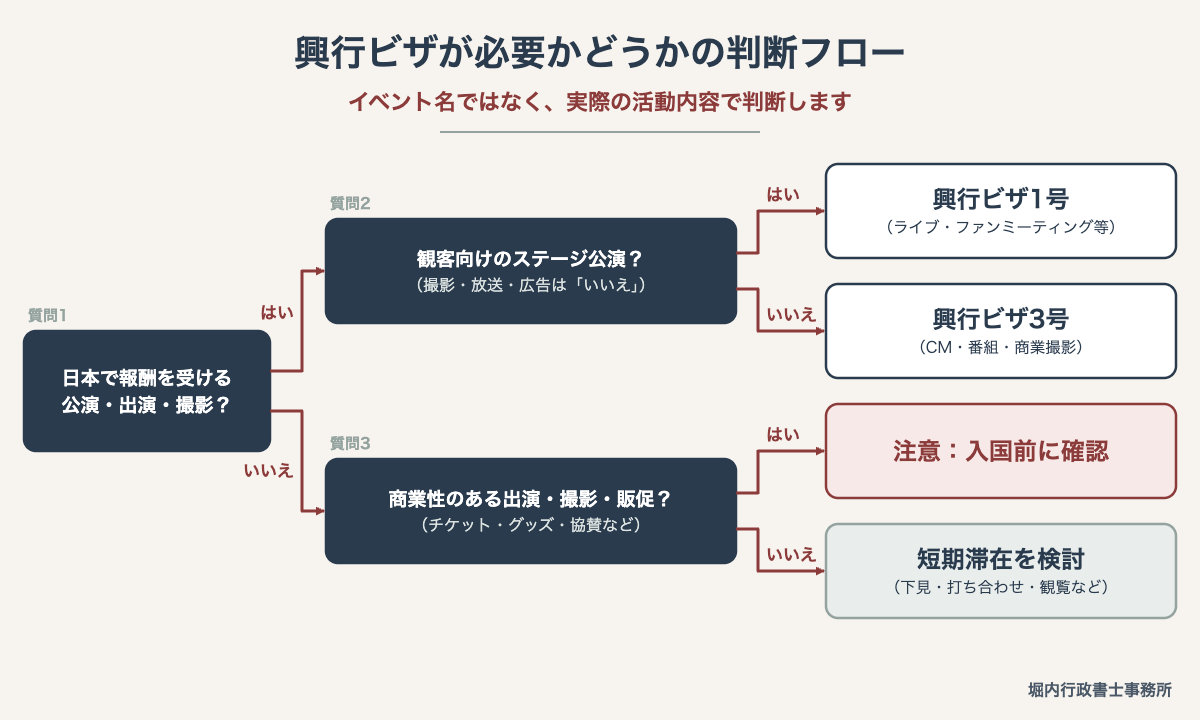
A single visit to Japan may include both performances and shoots. In this case, all activities are explained in the application form and supporting materials. If only part of the schedule is included in the application, the activities after arrival may not match the application.
Please check before entering Japan as a Temporary Visitor
Korean nationals can enter Japan without a visa as Temporary Visitors. However, paid performances or commercial shoots cannot be carried out under Temporary Visitor status. Engaging in activities that fall under Entertainer while on Temporary Visitor status may be treated as unauthorized activities and could affect future entry and examinations. If you are unsure whether Temporary Visitor status is sufficient, it is best to check before coming to Japan.
3. Which category applies to K-POP concerts and fan meetings?
For K-POP performances, applications are in many cases considered under Category 1(b)(4) (type based on venue conditions) or Category 1(a). This depends on the venue conditions and the track record of the inviting organization in Japan. Category 1(b) has five types, including performances hosted by national or local governments and performances at schools; the ones most often used for K-POP performances are (4) and (5).
- Category 1(b)(4): A venue with 100 or more seats where paid food and drink or hospitality are not provided in the audience seating (or a facility operated by a non-profit organization). Arenas, halls, live music clubs, and similar venues qualify. According to immigration bureau guidance, standing-room live music clubs may also qualify.
- Category 1(b)(5)(type based on remuneration): When the remuneration from the performance (for a group, the total for the entire group) is 500,000 yen or more per day and the stay is within 30 days.
- No. 1I: When the inviting organization meets the requirements. These include having a manager or executive with a total of 3 or more years of experience in entertainment business involving foreign nationals and having paid all remuneration in full over the past 3 years. Applications can be made regardless of the number of seats at the venue (excluding performances at hospitality restaurants and similar establishments under the Entertainment Business Act). For organizations that have previously received a Certificate of Eligibility under Category 1(a), the process is operated so that processing time is shorter (see Section 7 for details).
- No. 1 C: When neither (a) nor (b) applies. This includes performances at small establishments serving food and drink, and the requirements are the most detailed. Requirements include the applicant's experience (2 years or more), a contract of 200,000 yen or more per month, 5 or more full-time employees at the inviting organization, and the size of the stage and dressing rooms.
TV appearances and commercial shoots fall under Category 3. Categories 2 (sports, etc.) and 3 require remuneration equal to or more than what a Japanese national would receive for the same work. Make sure the performance contract clearly states the amount of remuneration and the payment method.
4. Do staff such as managers and hair and makeup artists also need visas?
Staff working on site in Japan should, as a rule, also apply for "Entertainer" together with the performers. This is because performances and shoots depend not only on the performers themselves but also on the work of the staff.
Those who often need to apply include the following.
- Managers (on-site coordination, accompanying performers)
- Hair and makeup artists, stylists
- Choreographers, backup dancers, band members
- Stage staff for sound, lighting, video, etc.
- Filming and production staff from Korea
On the other hand, people who will not work in Japan, such as accompanying family members or observers, should consider Temporary Visitor status. However, even among "accompanying persons," the decision varies depending on their role. It is important to list the names and roles of everyone coming to Japan at an early stage.
Our fees also count managers and staff in the number of applicants. The larger the tour, the more the preparation centers on organizing the roster and each person's role. In one case, we filed applications for 8 members and staff together (see the table in Chapter 7).
5. What does the inviting organization in Japan need to prepare?
The inviting organization prepares the performance contract, company documents, and venue documents. An Entertainer visa application is led by the inviting organization in Japan. The inviting organization is the company that contracts with the artist to hold performances or filming in Japan, such as an event company, promoter, TV station, or advertising/production company.
For Korean artists, the performance contract is often concluded between the Japanese company and the artist's Korean management agency. In that case, it is important to clearly state the following points in the contract.
- The performing artists and staff, and the performance/filming schedule
- Amount of remuneration, payee (the agency or the individual), payment method, and payment timing
- Allocation of costs such as transportation and accommodation
Even if the Korean company has no Japanese subsidiary, an application can be filed if a Japanese event company or similar acts as the inviting organization. If remuneration is paid by a sponsor, we organize the documents so that the relationship between the sponsorship agreement and the performance contract is clear.
Performers from different management agencies may also perform together. We have handled a jazz festival featuring 4 Korean jazz artists from different agencies (see the table in Chapter 7).
Common stumbling points in the review and how to address them are as follows.
| Common problem | Common Cases | counter-measure |
|---|---|---|
| Deficiency of contract | The remuneration amount is stated, but the payee, payment method, and payment timing are not | State the remuneration amount, payee, payment method, and payment timing in full |
| Inconsistent venue documents | The number of seats or whether food and drinks are served does not match between the venue documents and the application | Gather the latest documents, such as the venue's seating chart and terms of use |
| Requirements for the inviting organization | Unable to demonstrate the experience requirement or remuneration payment record under Category 1(a) | Consider another category, such as Category 1(b) |
| Changes in schedule or number of people | Members or staff are added or replaced after the application is filed | Finalize the roster early, and consult us immediately if anything changes |
6. Required documents: applicant, inviting organization, and contract documents
The required documents fall broadly into the following 3 groups. When inviting people from overseas, you apply for a Certificate of Eligibility (COE).
Examples of documents to submit (COE application, inviting from overseas)
Applicant's documents
- Application form and photo (4 cm high × 3 cm wide, taken within 6 months)
- A copy of your passport
- Documents showing career and track record (performance history, appearances, articles, etc.)
Documents of the inviting organization
- Certificate of registered matters and latest financial statements
- Company profile (documents showing its track record in entertainment events)
- List of executives and full-time employees, and a written declaration (for Category 1(a))
Contract and performance documents
- Performance contract (showing the remuneration amount and payment method)
- Performance/filming schedule, flyers, and announcement pages
- Venue documents (number of seats, facility overview, etc.)
Required documents vary depending onThe category of activity(Category 1(a), (b), (c), Category 2, Category 3), the inviting organization’s track record, and the venue conditions. We provide a document list tailored to your situation.
In practice, documents coming from Korea tend to take time. Contracts with the management agency and track-record materials are often written in Korean. We translate the documents needed for the application free of charge (with no page limit).
7. How many days does it take from application to entry?
When inviting from overseas, we recommend starting preparations at least 40 days before the performance. The published COE processing time is about 15 days. The 40 days include document preparation, our application preparation (within 7 business days after all documents are ready), the COE review, and the visa application.
We also accept requests with less than 40 days before the performance. However, we cannot guarantee that the result will be issued before the performance date.
When you make a request, please prepare the following 3 items.
- Performance/filming schedule and venue
- Names and roles of everyone coming to Japan
- Performance contract (draft)
The general flow is as follows.
- 40+ days before the performance: Request, confirmation of activities and category, and provision of the document list
- Within 7 business days after all documents are ready: We apply for the COE at the Regional Immigration Services Bureau
- About 15 days after application: COE issuance (15.3 days according to the Immigration Services Agency's published figures for August 2026 approvals. In our cases, filming (Item 3) took 3 days to 1 week, and performances/fan events (Item 1) took about 6 days to 3 weeks)
- After the COE is issued: Apply for a visa at the Embassy or Consulate-General of Japan in Korea (for processing days, please check the information from the Embassy/Consulate-General of Japan in Korea)
- Within 3 months of COE issuance: Enter Japan
For Category 1(a) applications, target processing times have been set on a trial basis for the time being. For organizations that have previously received a COE under Category 1(a) (Category 1), it is within 2 weeks of acceptance if there are no issues (within 3 weeks if the inviting organization’s executives or full-time employees have changed since the previous application). For other organizations (Category 2), it is within 1 month if there are no issues.
If you are in a hurry, an express plan is also available. We file the application within 3 business days from the day all documents are ready and payment of the express fee is confirmed. Note, however, that the express plan shortens only the preparation period before filing. It does not shorten the immigration bureau's processing time.
Actual cases handled by our office (from application acceptance to COE issuance) are as follows.
CASE · Performance
K-POP artist
Fan event in Odaiba, Tokyo
2 weeksScreening
CASE · Performance
K-POP artist
Members and staff applied for together
6 daysScreening
CASE · Performance
K-POP artist
A large team applied for together
3 weeksScreening
CASE · Event
A YouTuber's
event appearance in Japan
6 daysScreening
CASE · Performance
Jazz festival
Artists from different management agencies
2 weeksScreening
CASE · Performance
British rock band
Performances at 3 Tokyo venues in one application
2 weeksScreening
CASE · Filming
Korean cosmetics
advertising model shoot
3 daysScreening
CASE · Filming
A publisher's
interview shoot
1 weekScreening
Processing times vary depending on the content and timing. We cannot guarantee the same period.
Client Testimonials
Google Maps reviews. These are reviews from clients who requested services other than Entertainer visas, with the type of request noted.
They responded very quickly from start to finish and explained each of my questions carefully and clearly, so I was able to proceed with the procedure with peace of mind.
— Visa renewal client, Google Maps review
The gyoseishoshi could communicate in Korean and had even lived in the Korean city where I live, so I felt at ease from the start and could entrust everything with confidence. Thanks to her careful and prompt support with complicated paperwork, I successfully obtained permanent residency.
— Permanent residency client, Google Maps review
Even in an urgent situation with very little time left before my visa expired, she responded quickly, and I was able to obtain a visa I thought would be difficult. …Her Korean was very fluent, so I could proceed with great peace of mind. (Translated from the original Korean)
— Visa application client, Google Maps review
8. How much does the Entertainer visa cost?
Our fee is99,000 yen (tax included) for a single applicant. From the second person onward, the per-person rate decreases with the number of people. For example, applying for 10 people together, including managers and staff, costs a total of 577,500 yen, orabout 57,750 yen per person. Managers and staff are included in the headcount. These fees apply to Certificate of Eligibility applications. Changes and extensions are quoted separately, and actual expenses are charged separately.
- There is no immigration fee for a COE application.
- The express plan (application filed within 3 business days) is 1.3 times the total fee.
- Translation of documents required for the application is free.
- Change of status of residence and extension of period of stay are quoted separately.
Let us know the performance schedule, the number of performers and staff, and the venue, and we will provide a quote. You can check the fee table by number of people on the page below.
We answer general questions free of charge. If you need us to determine the category or required documents for a specific event, please use our paid consultation (Google Meet, 22,000 yen per hour). If you formally engage us, the consultation fee will be deducted from our fee.
Frequently Asked Questions
What if the performance is canceled or postponed after the COE application?
If the schedule changes, please contact us as soon as possible. Depending on the circumstances, an explanation to the immigration bureau or a new application may be required.
Can a tour visiting multiple cities be covered by a single application?
You can apply by submitting the schedules and venue documents for all performances together. However, each venue must meet the requirements of the category being applied for. We have also handled a case where performances at 3 venues in Tokyo were applied for together, and all were approved.
What happens if the performance schedule changes after the COE is issued?
A COE is valid for 3 months from issuance, and you must enter Japan within this period. If the schedule changes significantly or the activities change, a new application may be required, so please consult us first.
What if some members are not Korean nationals?
Regardless of nationality, the Entertainer status of residence is required. When inviting from overseas, the COE is usually obtained in Japan first, and then the visa is applied for. Each member applies for the visa at the Japanese Embassy or Consulate-General in the country where they live.
Related Articles
- What is an Art Visa? Difference from Entertainment Visa, Required Documents, and Points for Examination
- What Is a Cultural Activities Visa? Eligibility, Period of Stay and Required Documents [2026]
summary
To hold performances for audiences or to do commercials, TV programs, or commercial filming in Japan, an Entertainer visa is generally required. Performances generally fall under Item 1, and filming/appearances under Item 3. The determination is based on the actual activities, not the event name. On-site staff may also need to apply, so it is important to prepare early, working backward from the performance date.
Our office receives about 1,000 visa consultations of all kinds each year. As a certified immigration application agent, we handle everything from filing with the immigration bureau to receiving the result.
For details, seeEntertainer visa fees and support servicesfor more information.
For consultations about a specific event, please reach us viaContact Us.
We hope this article is helpful as you prepare for Korean artists' performances or filming in Japan.
[Reference Materials]
- Immigration Services Agency of Japan, "Status of Residence: Entertainer"
- Immigration Services Agency of Japan, "Amendments to the Ministerial Ordinance on Landing Criteria for the Entertainer Status of Residence"
- e-Gov Law Search, "Ministerial Ordinance Establishing the Criteria under Article 7, Paragraph 1, Item 2 of the Immigration Control and Refugee Recognition Act"
- Immigration Services Agency of Japan, "Residence Examination Processing Times (Days)", approvals for August 2026 (Reiwa 8) (PDF)
- Immigration Services Agency of Japan, "Photo Specifications for Submission"
(Confirmed November 6, 2026)

ABOUT US
Horiuchi Gyoseishoshi Office

Administrative Scrivener Yukiko Horiuchi
- Member of Shinjuku Branch, Tokyo Gyoseishoshi Association
- Tokyo Immigration and Residency Management Bureau, Application Agency Gyoseishoshi Scrivener
- Member of Foreign Employment Support Organization (FESO)
Access
- 1 minute walk from Higashi-Shinjuku Station on the Tokyo Metro Fukutoshin Line
- 1 minute walk from Higashi-Shinjuku Station on the Toei Oedo Line
- 10-minute walk from Seibu-Shinjuku Station (Seibu Shinjuku Line)
- 10-minute walk from Shin-Okubo Station (JR Yamanote Line)
- 15-minute walk from Shinjuku Station on the JR Yamanote Line
- 15-minute walk from Okubo Station (JR Chuo-Sobu Line)
If you have any questions regarding residency status (visas), permanent residency, naturalization, or starting a business, please feel free to contact us.