How to Write a Statement of Reasons for a Permanent Resident Application | Explaining Adverse Circumstances and Examples
 Yukiko Horiuchi
Hello. I’m Yukiko Horiuchi, a certified administrative scrivener at the Horiuchi Administrative Scrivener Office.
“Is it absolutely necessary to submit a statement of reasons for my permanent residence application?” “I’ve been late on tax payments in the past. Should I avoid mentioning this in my statement of reasons?” These are common questions we hear during consultations regarding permanent residence applications. The statement of reasons is a document in which the applicant personally explains circumstances that cannot be fully conveyed through the application form or supporting documents alone. If you have a history of late payments or late filings, how you explain those circumstances is particularly important. This document is often prepared not only by the applicant but also with the help of a Japanese spouse or a representative from the employer. In this article, we’ll examine when a Statement of Reasons is required, what to include, and how to address unfavorable circumstances, using actual cases from our firm as examples.

Three key points of this article
- When applying for permanent residency from a work visa, family stay status, or long-term resident status,The statement of reasons is one of the required documents(Format is flexible. If written in a language other than Japanese, a translation is required.) Even for spouses of Japanese nationals, documents such as pension and health insurance receipts, etc.If there are documents that are difficult to submit, please provide a written explanation stating the reason....will be displayed.
- The guidelines regarding permanent residence permits cover obligations such as paying taxes, paying pension and health insurance premiums, and filing notifications under the Immigration Control Act, among others.Are they fulfilling their duties properly?...will be reviewed. If you did not pay by the original due date, even if you have since paid in full, this will generally be viewed negatively.
- Don't hide any unfavorable circumstances, and"Facts → Background → Resolution → Prevention of Recurrence"The basic approach is to explain them in that order. Since a statement of reasons alone is not sufficient to resolve the issue, you should prepare it along with supporting documents.
1. Is a statement of reasons required for a permanent residency application?
It depends on your current status of residence. According to the Immigration Services Agency of Japan’s guidelines on required documents, the categories are as follows:
| Current Status of Residence | statement of reasons | Contents of the Guide |
|---|---|---|
| Work Visas (Technical, Humanitarian Knowledge, International Business, etc.) · Family Residence | Required Documents | Write a statement explaining why you need a permanent residence permit in any format. If you write in a language other than Japanese, a translation is required. |
| Permanent Resident | Required Documents | Write the reason why you need a permanent residence permit |
| Spouses and biological children of Japanese nationals or permanent residents | Not required in the list | If there are documents that are difficult to submit, such as pension or health insurance receipts, please submit a written explanation stating the reason. |
Even if it is not required, if there are circumstances that could lead to misunderstandings based solely on the documents, it is recommended that you explain them in advance in a statement of reasons. This is because, while the records alone might make you appear to be someone who “failed to meet the deadline,” if you provide both the background and your current situation, the examiner will be able to make a decision with a full understanding of the circumstances.
2. What should I write in the statement of reasons for my permanent residency application?
There is no set format. However, once you understand what the review process focuses on, the content you need to include will become clear. The guidelines regarding permanent residence permits list the following legal requirements: (1) good conduct; (2) possession of sufficient assets or skills to support oneself independently; and (3) a determination that the applicant’s permanent residence is in the interest of Japan. Regarding point (3), the review process verifies whether the applicant has properly fulfilled obligations such as paying taxes, contributing to public pension and health insurance premiums, and submitting notifications as required by the Immigration Control Act.
At our firm, we structure the statement of reasons in accordance with these guidelines, following the order listed below.
- Purpose of the Application (From which status of residence are you applying for permanent residence?)
- How He Came to Japan and His Career in Japan
- Family Situation (Spouse and Children, if any; Background of the Marriage and Current Living Situation)
- Basic Needs (Housing, Work, Income)
- Status of Compliance with Public Obligations (Taxes, Social Security, Health Insurance, and Filings)
- Additional Circumstances (Explain any adverse circumstances here)
- Reasons for Seeking Permanent Residency and Future Life Plans
- Conclusion
List each piece of information only once. Include your income in the “Work History” section and your tax payments in the “Public Obligations” section; by avoiding repetition elsewhere, you’ll make your statement of reasons easier for the examiner to read.
3. How should I describe adverse circumstances in the statement of reasons?
First and foremost, don’t try to hide anything. Records of payments and filings are verified using government records and submitted documents. Even if you don’t mention it in your statement of reasons, it will come to light during the review process. It’s much more likely to lead to a favorable outcome if you explain the circumstances yourself rather than having them discovered without any explanation.
It’s not enough to simply say, “I’ve paid everything now.”
The guidelines regarding permanent residence permits state that, even if payment has been completed by the time of application, failure to pay by the original deadline will generally be viewed negatively. Therefore, in your statement of reasons, you must explain both the “circumstances leading to the delay” and the “changes you have made to prevent a recurrence.”
We'll organize the adverse circumstances in the following four steps.
Order of Listing Adverse Circumstances
- Fact: Write about what happened and when, without hiding anything
- Background: Explain why it happened (as an explanation, not an excuse)
- Solution: Proof that payments and filings have been completed, along with supporting documentation
- Preventing Recurrence: Measures taken to ensure this does not happen again, such as switching to direct debit
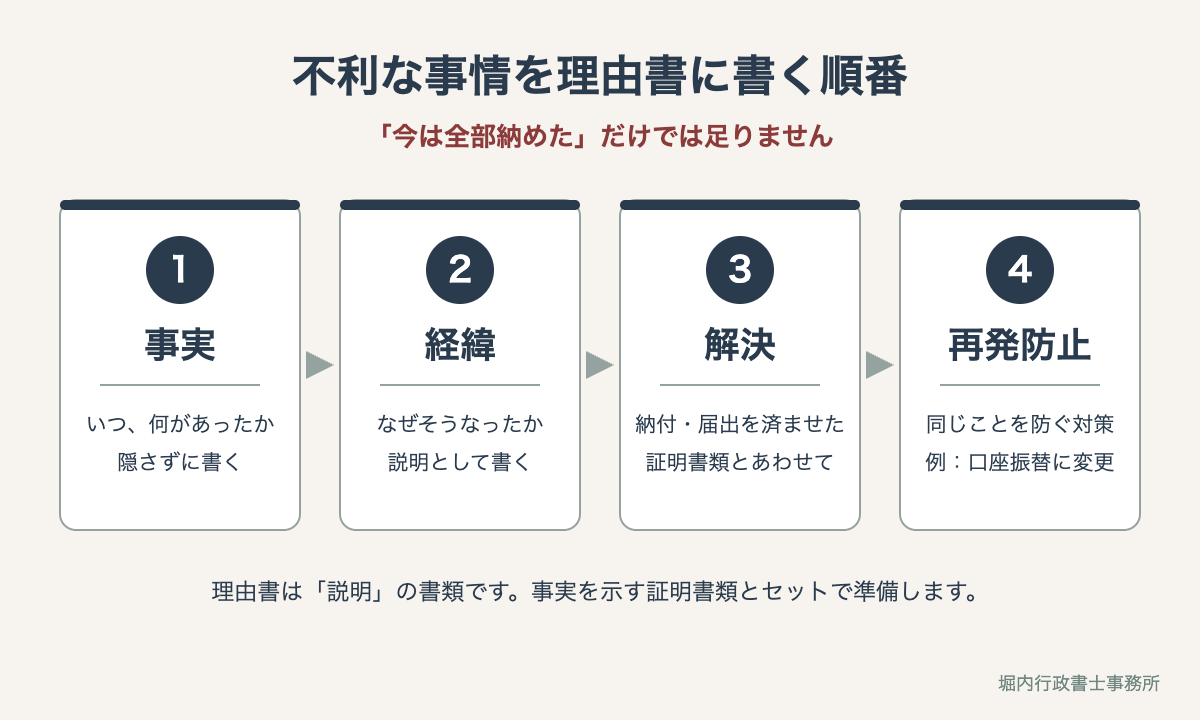
A statement of reasons is, after all, merely a document intended to provide an “explanation.” Only when it is accompanied by documents that demonstrate facts—such as proof of payment or a record of receipt of a filing—does the explanation become persuasive.
4. Here's how to explain this situation
Let’s look at how to explain things in a statement of reasons, using examples of common situations we encounter during consultations.
I lost my payment receipt.
If your resident tax is not withheld from your salary and you pay it yourself, you must provide proof—such as a copy of your bank statement or a receipt—that you paid it by the deadline. For pension and health insurance, you will also need documentation showing your payment history for the past two years. The Japan Immigration Services Agency advises that you keep receipts and other relevant documents for the required number of years. If you lose your receipts and cannot prove that you paid on time, your case may be viewed unfavorably.
In such cases, one option is to wait until the period for which you cannot provide proof falls outside the timeframe reviewed during the screening process (for residents’ tax: the most recent 5 years for those with work authorization; the most recent 3 years for spouses of Japanese nationals, etc.; and for pension and health insurance: the most recent 2 years) before submitting your application. Even then, do not conceal your past circumstances; instead, explain in your statement of reasons why you lost the receipts and how you plan to store them in the future.
Has a history of traffic violations
The guidelines list “good conduct”—that is, abiding by the law and leading a life free from social censure—as a requirement. If you have a history of minor traffic violations, do not conceal this fact; instead, consider submitting a statement of reflection that summarizes the circumstances of the violations, your remorse, and how you have improved your driving habits. Although a statement of reflection is not a required document, it serves as supporting material to explain your circumstances.
There was a delay in reporting the affiliated organization
Individuals residing in Japan under a work visa or similar status are required to file a “Notification Regarding the Employing Organization” within 14 days when they leave or change their employing organization (such as a company) (Article 19-16 of the Immigration Control Act). This notification is also included in the “obligations to file notifications, etc., as stipulated by the Immigration Control Act” referred to in the guidelines. If the deadline has passed, you must first submit the notification, then write a statement explaining the reason for the delay and measures to prevent recurrence, and submit it along with your application. It is also advisable for personnel in charge at companies that employ foreign employees to review the notification procedures for resignations and new hires at least once for peace of mind.
5. Actual Cases Handled by Our Firm
These are actual cases our firm has handled. Names and locations have been withheld.
CASE · Permanent Residency
Spouse's Resident Tax
Confirm Payment Was Made by the Due Date
statement of reasonsApproved
The applicant’s spouse did not have a receipt for the resident tax payment and was unable to prove that the payment had been made by the deadline. We confirmed with the ward office that the payment had indeed been made by the deadline, summarized this information along with measures to prevent a recurrence in a written explanation, and submitted it. As in this case, there may be instances where payment documents from a spouse are required.
These case studies are intended to illustrate the services provided by our firm; results may vary depending on individual circumstances, and we cannot guarantee the same outcome.
6. Common Mistakes in Statements of Reason
- It simply lists the applicant's work history, but does not explain why permanent residency is necessary.
- The same content is repeated in multiple places.
- Failing to mention unfavorable circumstances, or providing a long-winded excuse
- There is no supporting documentation; it consists solely of an explanation.
- Written in a language other than Japanese, without a translation provided
7. Our Firm’s Support for Preparing Statements of Reasons
The Statement of Reasons is a document in the applicant’s name. Therefore, rather than writing it on the applicant’s behalf, our office assists the applicant in drafting it based on their specific circumstances and provides feedback. First, we ask you to complete a 14-item questionnaire (covering family circumstances, living conditions, employment and income, taxes, pensions, and health insurance, immigration history, past adverse circumstances, future plans, etc.), and we assist you in compiling this information into a Statement of Reasons written in Japanese that is easy for the immigration officer to read. If there are any inconsistencies or omissions in your answers, we will verify them with you before incorporating them into the Statement of Reasons. We also accept responses in Korean.
Frequently Asked Questions
Can the statement of reasons be written in a language other than Japanese?
You may write it in another language, but if you do, you’ll need a translation. Since the examiner will be reading the Japanese version, it’s best to write it in Japanese from the start to ensure the content is conveyed accurately.
What is the recommended length for a statement of reasons?
There is no set length. It is important to include all relevant details and avoid repeating the same information. If there are few details to explain, a short response is sufficient.
Related Articles
- Guide to Applying for Permanent Residency in Japan | Requirements, Documents and Common Reasons for Denial [2026]
- Summary of the Revised Permanent Residency Guidelines | Income, Pension and Japanese Language [2026]
- Japan Permanent Residency Application: 20 Q&As | Frequently Asked Questions
summary
The statement of reasons for a permanent residency application is a document that directly conveys aspects of your life and circumstances that aren’t evident from the paperwork alone. If you have ever been late with payments or filings, the basic rule is to be transparent about it—clearly explaining the circumstances, how the issue was resolved, and measures taken to prevent recurrence—and to submit this information along with supporting documentation. Since the timing of your application can also affect the review process, if you have any unfavorable circumstances, please review your situation carefully before applying.
We hope this article will be of some help to you as you prepare your application for permanent residency. For information on fees and services, please see “Permanent Residency Application Support | Our Process and Fees"You can view this here." We provide answers to general questions free of charge. If your specific circumstances require a case-by-case assessment, you can schedule a paid consultation (22,000 yen for 1 hour via Google Meet; this fee will be deducted from your payment if you formally retain our services). If you have any questions, please see "Contact Us"Feel free to contact us."
[Reference Materials]
- Japan Immigration Services Agency: "Application for Permanent Residence"
- Immigration Services Agency of Japan: “Application for Permanent Residence 1 (Spouses and Biological Children of Japanese Nationals, Permanent Residents, and Special Permanent Residents)”
- Immigration Services Agency of Japan: “Application for Permanent Residence 3 (Work Status/Family Stay)”
- Japan Immigration Services Agency: “List of Documents Required for Permanent Residence Applications (Other Than Work-Related Status)”
- Immigration Services Agency of Japan, “Guidelines on Permanent Residence Permits”
- Japan Immigration Services Agency: “Notification Regarding Affiliated Organizations”
(Verified November 12, 2026)

ABOUT US
Horiuchi Gyoseishoshi Office

Administrative Scrivener Yukiko Horiuchi
- Member of Shinjuku Branch, Tokyo Gyoseishoshi Association
- Tokyo Immigration and Residency Management Bureau, Application Agency Gyoseishoshi Scrivener
- Member of Foreign Employment Support Organization (FESO)
Access
- 1 minute walk from Higashi-Shinjuku Station on the Tokyo Metro Fukutoshin Line
- 1 minute walk from Higashi-Shinjuku Station on the Toei Oedo Line
- 10-minute walk from Seibu-Shinjuku Station (Seibu Shinjuku Line)
- 10-minute walk from Shin-Okubo Station (JR Yamanote Line)
- 15-minute walk from Shinjuku Station on the JR Yamanote Line
- 15-minute walk from Okubo Station (JR Chuo-Sobu Line)
If you have any questions regarding residency status (visas), permanent residency, naturalization, or starting a business, please feel free to contact us.