Work Visa (Technical/Professional/National) Requirements, Required Documents, and Processing Time | For Companies Hiring South Koreans [2026]
 Yukiko Horiuchi
Hello. I’m Yukiko Horiuchi, a certified administrative scrivener at the Horiuchi Administrative Scrivener Office.
Once a Korean candidate has been hired, the first questions HR staff usually face are: “Can this person get a visa with their academic background?”, “What does the company need to prepare?”, and “Will it be ready by the start date?” Korean nationals who have secured a job in Japan often have the same questions.
In this article, we will look at the status of residence “Engineer/Specialist in Humanities/International Services,” the core work visa, covering how Korean academic credentials are treated, the additional documents required from April 2026, required documents by company category, a schedule planned backward from the start date, and fees.

Three key points of this article
- The core of the review for a work visa (Engineer/Specialist in Humanities/International Services) is the connection between the major (courses taken) at university or similar institution and the duties to be performed in Japan. A degree from a Korean four-year university qualifies, and graduation from a Korean junior college can be submitted as graduation from an institution equivalent to a Japanese junior college (the final decision rests with the immigration bureau).
- From April 15, 2026, companies in Category 3 or 4 must submit a “Declaration Regarding the Representative of the Affiliated Organization.” If the employee of a Category 3 or 4 company will perform customer-facing work that uses language, such as translation/interpretation or hotel front desk duties, proof of proficiency in the language used for the work (e.g., JLPT N2 or higher for Japanese) is also required.
- When inviting someone from overseas, the published processing time for a COE is about 47 days. We recommend starting preparations 3 to 4 months before the start date.
1. What is a work visa (Engineer/Specialist in Humanities/International Services)? Eligible jobs
A work visa (Engineer/Specialist in Humanities/International Services) refers to the status of residence “Engineer/Specialist in Humanities/International Services.” It is a status of residence for working at a Japanese company using specialized knowledge acquired at university or similar institutions, or an understanding of foreign cultures. “Work visa” is a common term; strictly speaking, it refers to a “status of residence for the purpose of employment.” Among these, Engineer/Specialist in Humanities/International Services is the most widely used.
Engineer/Specialist in Humanities/International Services is broadly divided into three fields.
| Field | Examples of Primary Duties | Key Requirements |
|---|---|---|
| Technology (Science Fields) | System engineers, programmers, mechanical designers, construction project managers, etc. | Graduation from a university in a related field, graduation from a Japanese vocational school, or 10 or more years of practical experience |
| Humanities (Liberal Arts) | Accounting, finance, general affairs, sales, legal affairs, marketing, etc. | Graduation from a university in a related field, graduation from a Japanese vocational school, or 10 or more years of practical experience |
| international service | Translation and interpretation, language instruction, international business operations, designers, etc. | At least 3 years of professional experience (not required for college graduates working in translation, interpretation, or language instruction) |
For information processing work, if you have passed an information technology examination designated by the Minister of Justice or hold a designated qualification, you may be able to apply even without meeting the education or work experience requirements.
The period of stay is 5 years, 3 years, 1 year, or 3 months. The period granted is determined in the review based on factors such as the company category and the term of the employment contract.
If you are transferring from a head office or affiliated company in Korea to a Japanese subsidiary or branch, consider “Intra-company Transferee” rather than Engineer/Specialist in Humanities/International Services. The requirements differ, such as whether you have worked overseas for at least one year. For details, seeIntra-company Transferee Visa (Expat Visa) Application Supportfor more information.
Notice for employers
- If a company employs a person whose status of residence does not permit work, the company may also be charged with the crime of promoting illegal employment.
- Even if the company did not know the foreign national was working illegally, it may still be punished if it was negligent, for example by failing to check the residence card.
- When hiring someone living in Japan, always check their residence card for their status of residence, period of stay, and any work restrictions.
2. What are the education and major requirements? How Korean academic credentials are treated
As a rule, graduation from a university (or equivalent or higher education) or from a Japanese vocational school is required. If you do not have such education, you apply based on 10 or more years of practical experience (3 or more years for international services). In addition, what you studied must be related to the duties you will perform in Japan.
How are Korean academic credentials treated in the Japanese review?
Degrees from Korean four-year universities, junior colleges, and the Academic Credit Bank System can be considered for meeting the education requirement. General guidelines for each type of Korean academic credential are as follows.
| Korean academic credential | Treatment in the Japanese review (guideline) |
|---|---|
| Four-year university (bachelor's degree) | Treated as university graduation. |
| Junior college (2- or 3-year program, associate degree) | You can apply on the basis that this meets the education requirement as graduation from an institution equivalent to a Japanese junior college (whether it is equivalent is ultimately determined by the immigration bureau). |
| Academic Credit Bank System (bachelor’s or associate degree) | Treated the same as a regular university degree. A bachelor's degree is regarded as equivalent to graduation from a four-year university, and an associate degree as equivalent to graduation from a junior college. |
| Cyber university | This varies by school and program, so individual confirmation is required. |
| High school graduation | Does not meet the education requirement. You must prove 10 or more years of practical experience (3 or more years for international services) with certificates of employment or similar documents. |
| Japanese vocational school (Diploma / Senmonshi) | Eligible if you graduated from a Japanese vocational school and hold the title of “Senmonshi” (Diploma). The connection between your major and job duties is reviewed more strictly than for university graduates. |
Korean graduation certificates and academic transcripts must be submitted with Japanese translations. If your résumé has gaps such as military service, stating those periods clearly will make the review of your career history smoother.
Can I apply with a degree from the Academic Credit Bank System or a cyber university?
Degrees from the Academic Credit Bank System are accepted. Cyber universities require individual confirmation.
In all cases, what matters more in the review is the connection between your major (courses taken) and the duties you will perform in Japan. Whether the courses on your transcript relate to the job duties often affects the decision of approval or denial.
How closely must my major match my job duties?
The name of your major does not need to match the job exactly. What matters is whether you can explain how the courses on your transcript relate to the duties you will perform. University graduates are assessed relatively flexibly, while graduates of Japanese vocational schools are required to show a stronger connection between their major and job duties.
| Examples of majors in Korea | Examples of jobs where the connection is easy to explain |
|---|---|
| Business administration, economics, accounting | Sales, marketing, accounting, corporate planning |
| Computer engineering, information and communications | Systems engineer, programmer, in-house IT engineer |
| Mechanical engineering, architectural engineering | Mechanical design, construction management, production engineering |
| Japanese language and literature, translation and interpretation | Translation/interpretation, liaison for business with Korean companies |
| International trade, international commerce | Overseas transactions, import/export operations |
| Design | Graphic design, web design |
The content of the work also matters. Jobs that mainly involve tasks not requiring the knowledge you studied, such as factory line work or serving customers and stocking shelves in a store, are not permitted under Engineer/Specialist in Humanities/International Services. If on-site work is part of post-hire training, be prepared to explain its duration and content.
3. What changed in April 2026? Japanese proficiency and additional documents
For applications filed on or after April 15, 2026, additional documents are required for companies in Category 3 or 4. On the same day, the Immigration Services Agency of Japan partially revised its “Clarification of the Status of Residence” guidelines for Engineer/Specialist in Humanities/International Services and newly published materials on work that uses language (Attachment 4).
Additional documents for applications filed on or after April 15, 2026 (Category 3 and 4)
- Declaration regarding the representative of your institution
- If the person will mainly perform customer-facing work using language skills, such as translation/interpretation or hotel front desk duties, documents proving proficiency equivalent to CEFR B2 or higher in the language used for the work
For Japanese, the following are recognized as equivalent to B2.
- Japanese-Language Proficiency Test (JLPT) N2 or higher
- 400+ points on the BJT Business Japanese Proficiency Test
- JPT Japanese Proficiency Test score of 525 or higher
- Graduation from a Japanese university, vocational school, or similar institution (with a major related to the work)
According to Attachment 4, for languages other than Japanese, being a native or official language serves as proof of proficiency. Korean for Korean nationals is considered to fall under this. For interpretation or customer service work that also uses Japanese, it is advisable to prepare B2-equivalent documentation for Japanese as well (such as N2). Companies in Category 1 or 2 are not required to submit this at the time of application, but it may be requested during the review.
Even people already working in Japan must submit these documents when applying for an extension if, due to a job change or change in duties, their work has become mainly customer-facing work that uses language. For extensions where the person continues the same work, submission is generally not required. For details of the revision, seeFrom April 15, 2026: New requirements for translation/interpretation work under Engineer/Specialist in Humanities/International Services.
4. What are the company categories and required documents?
The documents required for hiring foreign nationals depend on which of four categories the employing company falls into. For companies in Category 1 or 2, the required documents are greatly simplified.
| Category | Typical companies | Documents (guideline) |
|---|---|---|
| 1 | Listed companies, national and local governments, incorporated administrative agencies, etc. | Fewest |
| 2 | Companies whose withholding tax amount on the previous year’s Total Table of Legal Records is 10 million yen or more, etc. | Few |
| 3 | Companies that have submitted the previous year’s Total Table of Legal Records (excluding Category 2) | Standard |
| 4 | Companies that do not fall under any of the above (such as newly established companies) | Most |
Small and medium-sized companies that submit the Total Table of Legal Records are usually Category 3. Companies that were recently established and have not yet submitted the Total Table of Legal Records are Category 4. In Category 4, a business plan may be submitted instead of financial statements.
Below is an example of the documents required when a Category 3 company hires someone who is overseas.
Examples of Required Documents (Category 3: When Sponsoring a Family Member from Abroad)
Applicant's documents
- Application form and photo (4 cm high × 3 cm wide, taken within 6 months)
- A copy of your passport
- Resume
- Certificates of degree and employment history (graduation certificate, academic transcript, etc.)
Employment documents
- Notice of Employment Terms (Employment Contract)
- Statement of reasons for employment
Company documents
- Certificate of registered matters and financial statements
- Summary of legal records (hotei chosho gokeihyo)
- Company profile
- Declaration Regarding the Representative of the Affiliated Organization (from April 15, 2026)
Required documents vary depending onthe company's categoryand the applicant's situation (education and work history, inviting from abroad vs. changing status within Japan). We provide a document list tailored to your situation.
The most important document is the statement of reasons for employment. It should specifically describe the job duties, a typical workday, the connection to the person’s major, and the reason for hiring that person. If you only write “hired as an interpreter,” the immigration bureau may check whether there is enough interpretation work. Explain the work so that both its volume and content are clear.
5. What should HR staff check before hiring?
Before hiring, check four points: job duties, connection to the major, salary, and the company category. Checking the following before making a job offer will make preparing the application smoother.
Checklist for HR staff
- The job duties involve the use of specialized knowledge or language skills
- You can explain the connection between the courses on the transcript and the job duties
- The salary is equal to or higher than that of a Japanese employee doing the same work
- The Notice of Employment Conditions states the job type, duties, salary, and place of work
- You have confirmed your company’s category (withholding tax amount on the Total Table of Legal Records)
- For customer-facing work that uses language, such as translation/interpretation or hotel front desk duties, there is proof of Japanese proficiency (N2 or higher, etc.) (Category 3 and 4)
- For someone living in Japan, you have checked their status of residence and period of stay on their residence card
- You have decided on the start date and the application timing planned backward from it (see 7. Schedule)
Applications are more likely to be denied in cases such as the following.
| Common problem | Common Cases | counter-measure |
|---|---|---|
| Connection between major and job duties | No visible connection between the courses on the transcript and the job duties | Describe the job duties specifically and show the relevant courses in the statement of reasons for employment |
| Content of the work | The work mainly consists of on-site labor or simple customer service | Organize the proportion and content of specialized work |
| Remuneration | The salary is lower than that of Japanese employees doing the same work | Set it with reference to the company’s internal pay scale |
| Stability of the company | The company was just established and the substance and continuity of its business are not clear | Explain with a business plan and transaction records |
| Past residence history | Part-time work during study exceeded 28 hours per week | Confirm the facts and consult before applying |
Even after a denial, you may be able to reapply by confirming the reasons and preparing your documents properly. You can ask the Regional Immigration Services Bureau about the reasons for the denial.
6. Invite from overseas or change status within Japan?
When hiring someone living in Korea, apply for a Certificate of Eligibility (COE). When hiring someone living in Japan, apply for a change of status of residence.
| Types of Applications | In cases like this | Applicant |
|---|---|---|
| Application for Certificate of Eligibility (COE) | Inviting and employing someone who is in Korea or elsewhere overseas | A company employee or a certified immigration application agent applies on the person’s behalf |
| Application for Permission to Change Status of Residence | Employing someone who is in Japan, such as on a Student or Working Holiday visa | The person themselves (a certified immigration application agent can apply on their behalf) |
| Application for Extension of Period of Stay | Extending the period of stay (preparation differs depending on whether you changed jobs) | The person themselves (a certified immigration application agent can apply on their behalf) |
Korean nationals can enter Japan without a visa for short-term stays such as tourism. However, a work visa is required to work in Japan. Once the COE is issued, apply for a visa at the Embassy or Consulate-General of Japan in Korea, and enter Japan within 3 months of the COE’s issuance.
When changing status within Japan, apply by the expiration date of your period of stay. If you apply by the expiration date, you may continue to stay in Japan until a decision is made or until 2 months have passed from the expiration date, whichever comes first. A change from Temporary Visitor is not permitted unless there are unavoidable special circumstances. As a rule, even those who came to Japan as a Temporary Visitor for an interview must return home once and then enter with a COE.
Changing from a Student visa is explained in detail inChange from a college student visa to a work visa, and changing from a Working Holiday visa inChanging from a Working Holiday Visa to an Engineer/Specialist in Humanities Visa | An Approved Case Explained. For extensions after changing jobs, seeRenewing Your Work Visa After Changing Jobs | Review Points and Required Documents for the Engineer/Specialist in Humanities Visafor more information.
7. Will it be ready by the start date? Processing time and schedule
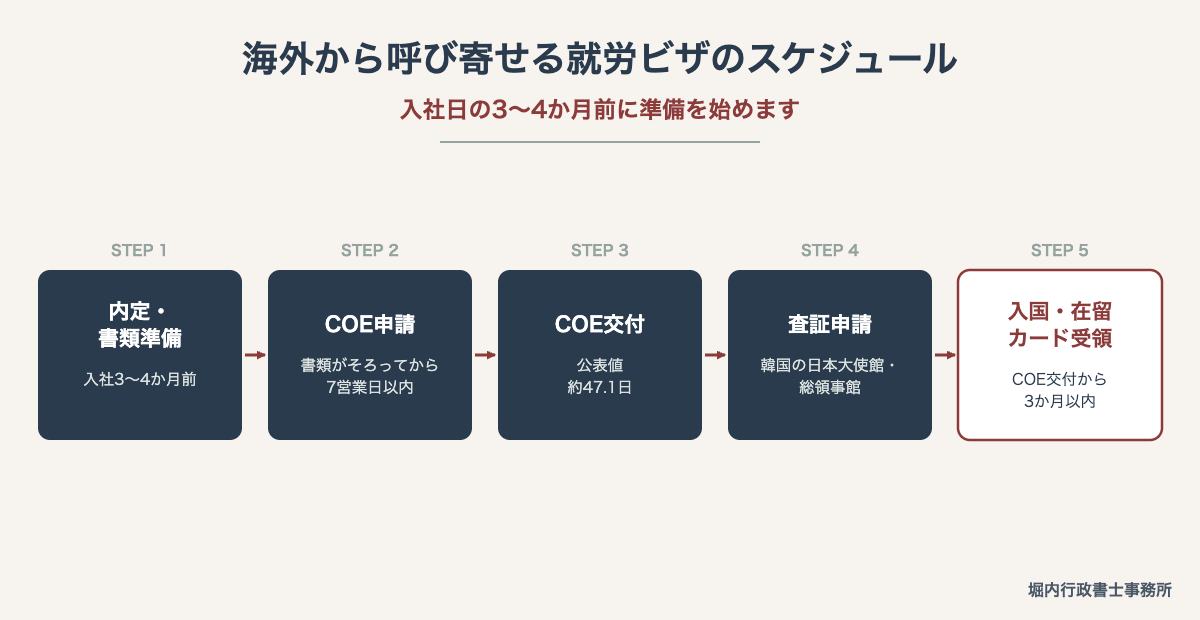
When inviting someone from overseas, we recommend starting preparations 3 to 4 months before the start date. According to figures published by the Immigration Services Agency of Japan (for approvals in August 2026), the processing time for a COE is 47.1 days. A change of status within Japan takes 51.3 days, and an extension takes 41.0 days. We recommend consulting us at least 3 months before the planned start date.
The general flow is as follows.
| Timing (guideline) | what to do | (in) charge (of an area of responsibility, but not necessarily supervision of staff) |
|---|---|---|
| 3 to 4 months before the start date | Job offer, confirmation of job duties and education, creation of a document list | Company, applicant, and gyoseishoshi |
| By 3 months before the start date | Gather graduation certificates, transcripts, etc., and attach Japanese translations | the person himself |
| Within 7 business days after all documents are ready | Our office applies for the COE at the Regional Immigration Services Bureau | Administrative Scrivener |
| About 1.5 months after application | COE issued (published figure: 47.1 days) | Immigration Services Agency |
| After the COE is issued | Apply for a visa at the Embassy or Consulate-General of Japan in Korea | the person himself |
| Within 3 months of COE issuance | Enter Japan (receive residence card at the airport) | the person himself |
| Within 14 days of entry | Register your place of residence at the city/ward office | the person himself |
| After joining the company | Social insurance procedures and notification of employment of foreign nationals to Hello Work | Company |
Applications tend to concentrate around April new-graduate hiring and end-of-fiscal-year transfers, which can lengthen processing. If the start date is fixed, gather documents early.
If you are in a hurry, an express plan is also available. We file the application within 3 business days from the day all documents are ready and payment of the express fee is confirmed. Note, however, that the express plan shortens only the preparation period before filing. It does not shorten the immigration bureau's processing time.
Actual cases handled by our office
CASE · Change
Working Holiday →
Change to work visa
During the special extension periodApproved
CASE · New hire
New hire at a Japanese company
3 monthsScreening
CASE · Extension
Obtaining a Japanese language qualification
strengthened the connection to the job duties
During the special extension periodApproved
CASE · Change
Language school graduate →
Change to work visa
During the special extension periodApproved
CASE · Change
Dependent →
Change to work visa
During period of stayApproved
CASE · Freelance
Under a freelance contract
COE application
4 monthsScreening
CASE · Experienced hire
With proof of 10 years of practical experience
Hiring an animation director
6 monthsScreening
CASE · Change
During the departure preparation period
Change to a marketing position
3 weeksScreening
“Approved during the special extension period” refers to cases where approval was granted during the special extension period of waiting for the result after the original period of stay had expired. Processing time varies depending on the content and timing, and we cannot guarantee the same timeframe.
Client Testimonials
Google Maps reviewsare the source of these quotes. The service requested is noted alongside each review. Results and timeframes are specific to each case.
I used this office for my work visa application. I had been denied once and had no Japanese language qualification, so it was not an easy situation, but thanks to them, my COE was issued just 3 weeks after applying! Support in Korean, quick replies, meticulous documents — every step of the process was excellent. … (translated from the original Korean)
— Work visa client, Google Maps review
Due to a sudden transfer order, I asked them to handle my work visa and family visa. I am very satisfied that they consulted with me kindly in fluent Korean, that the procedure was simple, and that they also helped with matters other than visas. The visas were issued sooner than I expected… (translated from the original Korean)
— Work visa and Dependent client, Google Maps review
They handled everything carefully one by one, which was very reassuring. The result also came sooner than I expected, and they followed up until my residence card arrived, which was a great help. …
— Visa application client, Google Maps review
8. How much does a work visa cost? Government fees and our office's fees
The costs consist of the immigration fees (free for a COE; 33,000 yen at the counter for a 1-year change or extension) and our office’s fees (from 110,000 yen). There is no immigration fee for a COE application. For a change or extension within Japan, the fee is paid when the application is approved. Fees were revised for applications filed on or after October 1, 2026, and the amount now depends on the period of stay granted.
| Permitted Period of Stay | Counter application (revenue stamp) | Online Application |
|---|---|---|
| 1 year | 33,000 yen | 27,000 yen |
| 3 years (3 years or more but less than 5 years) | 64,000 yen | 56,000 yen |
| 5 years | 75,000 yen | 65,000 yen |
For online applications, a payment processing fee is charged in addition to the fee. Applications accepted by September 30, 2026 are subject to the fees before the revision.
Our office’s fees are as follows (all including tax).
| Types of Applications | Standard | Full Support |
|---|---|---|
| Certificate of Eligibility (COE) / Change | From 110,000 yen | From 132,000 yen |
| Extension (with job change) | From 88,000 yen | From 110,000 yen |
| Extension (no job change) | From 55,000 yen | From 77,000 yen |
- With the Standard Plan, you prepare the required documents, and our office handles everything from assisting with document preparation to filing the application as your agent and receiving the result.
- With the Full Support Plan, you can also leave the collection of documents within Japan to us.
- Both plans include analysis of the reasons and advice on reapplication in case of denial, as well as receipt of the residence card.
- The Express Plan is 1.3 times the total fee.
- We accept cases after reviewing your graduation certificate, transcript, Notice of Employment Conditions, etc., and determining that an application can be made.
The services included in each plan can be found atWork Visa Application Fees (Visa Application Support). Additional fees and actual expenses are also explained on the same page.
Frequently Asked Questions
What is the shortest time from job offer to start date?
Processing time varies depending on the content and timing of the application, so it is difficult to say for certain. According to figures published by the Immigration Services Agency of Japan (for approvals in August 2026), the processing time is 47.1 days for a COE and 51.3 days for a change of status within Japan. When inviting someone from overseas, a visa application and preparations for entry are also needed after the COE is issued. We recommend consulting us at least 3 months before the planned start date.
If I change jobs after joining, do I need to complete procedures right away?
When you change jobs, you must submit a “Notification Regarding the Organization of Affiliation” to the Immigration Services Agency of Japan within 14 days. If you are unsure whether your new job falls under Engineer/Specialist in Humanities/International Services, you can also apply for a Certificate of Authorized Employment to confirm.
Can I bring my family to Japan?
Your spouse and children can live with you under the “Dependent” status of residence. They can also apply at the same time as your own application.
Do all Korean-language documents need to be translated?
Documents in foreign languages must be submitted with Japanese translations. This mainly applies to graduation certificates, academic transcripts, certificates of employment, and similar documents. We provide a quote for translating the foreign-language documents required for your application based on their content.
Related Articles
- What Is a Certificate of Eligibility (COE)? The Application Process for Inviting Foreign Nationals to Japan from Abroad
- Intra-Company Transferee Visa Application Support | Requirements, Process and Our Fees
- Application for extension of period of stay (visa extension application)
summary
The review of a work visa (Engineer/Specialist in Humanities/International Services) centers on the connection between your major (courses taken) and your job duties. Degrees from Korean four-year universities, junior colleges, and the Academic Credit Bank System are eligible, and what matters is the connection between the courses on your transcript and the job. Since April 2026, additional documents are required for Category 3 and 4 companies, and proof of Japanese proficiency is required for work that uses language. When inviting someone from overseas, start preparing 3 to 4 months before the start date.
Our firm handles over 1,000 visa-related consultations annually. As licensed administrative scriveners authorized to file applications, we handle the entire process on your behalf—from submitting the application to the Immigration Bureau to receiving the results. We also offer consultations in Korean.
To start, please check the planned job duties, the graduation certificate and transcript, and your company’s category, and then contact us. For individual consultations,Contact Us.
We hope this article is helpful as you hire Korean nationals or prepare to work in Japan.
[Reference Materials]
- Japan Immigration Services Agency: “Status of Residence: ‘Specialized Professional’”
- Immigration Services Agency of Japan, “Clarification of the Status of Residence ‘Engineer/Specialist in Humanities/International Services’”
- Immigration Services Agency of Japan, “Attachment 4 (Clarification of the Status of Residence for Those Engaged in Customer-Facing Work Using Language Skills, Such as Translation and Interpretation)” (PDF)(Attachment 4 updated October 14, 2026)
- Immigration Services Agency of Japan, “Revision of Fees”interpoint (interword separation)Leaflet (PDF)
- Immigration Services Agency of Japan, "Residence Examination Processing Times (Days)", approvals for August 2026 (Reiwa 8) (PDF)
- Immigration Services Agency of Japan, "Photo Specifications for Submission"
(Confirmed November 6, 2026)

ABOUT US
Horiuchi Gyoseishoshi Office
Administrative Scrivener Yukiko Horiuchi
- Member of Shinjuku Branch, Tokyo Gyoseishoshi Association
- Tokyo Immigration and Residency Management Bureau, Application Agency Gyoseishoshi Scrivener
- Member of Foreign Employment Support Organization (FESO)
Access
- 1 minute walk from Higashi-Shinjuku Station on the Tokyo Metro Fukutoshin Line
- 1 minute walk from Higashi-Shinjuku Station on the Toei Oedo Line
- 10-minute walk from Seibu-Shinjuku Station (Seibu Shinjuku Line)
- 10-minute walk from Shin-Okubo Station (JR Yamanote Line)
- 15-minute walk from Shinjuku Station on the JR Yamanote Line
- 15-minute walk from Okubo Station (JR Chuo-Sobu Line)
If you have any questions regarding residency status (visas), permanent residency, naturalization, or starting a business, please feel free to contact us.

