Guide to Applying for Permanent Residency in Japan | Requirements, Documents, Processing Times, and Reasons for Denial [2026]
 Yukiko Horiuchi
Hello. I am Yukiko Horiuchi, a certified administrative scrivener at the Horiuchi Administrative Scrivener Office. Our office handles over 1,000 consultations annually and, as certified administrative scriveners authorized to file applications on behalf of clients, we assist with applications for various status-of-residence categories, including permanent residency.
"I've lived in Japan for 10 years—can I apply for permanent residency now?" This is the most common question we receive regarding permanent residency. In the actual screening process, however, rather than the number of years,Whether taxes, pension contributions, and health insurance premiums are being paid on time, and whether the household has a stable incomeThis often makes a difference in the outcome.
In this article, let’s take a look at everything you should check before applying—from the requirements for applying for permanent residency, the required length of stay, and the necessary documents, to the review period and common reasons for denial.
Key points of this article
- Permanent residency is judged bythree requirements: good conduct, independent livelihood and national interestIt is determined based on these three criteria, and as a general rule,Residence for more than 10 years (including at least 5 years under a work or residence visa)is required.
- Income isA level exceeding the average income of Japanese households based on household sizewill serve as the standard (already in effect), and changes to pensions, Japanese language proficiency level B1, and special provisions for spouses, etc.,Applications submitted on or after April 1, 2027...will apply starting from.
- The most common reason for denial isunpaid and late payment of taxes, pension and health insuranceThat's right. Even while your permanent residency application is pending, you still need to renew your current visa separately.
1. What Is Permanent Residency? How Does It Differ from Naturalization?
Permanent residency (the "Permanent Resident" status of residence) is a status that lets you live in Japan without time limitsWithout changing my nationalityThis is a status of residence that allows you to live in Japan indefinitely. Since this procedure is intended for individuals who already hold a different status of residence in Japan and wish to switch to “Permanent Resident” status, you cannot apply directly from overseas.
| (data) item | Permanent Residency | naturalization |
|---|---|---|
| nationality | Unchanged | Become a Japanese national |
| Renewal of Period of Stay | Not required (Residence Cards are renewed every 7 years; for those under 16, they are valid until their 16th birthday) | unnecessary |
| Activity restrictions | None (free to change jobs and start a business) | nashi (Pyrus pyrifolia, esp. var. culta) |
| Possibility of revocation | Yes (the revocation system expands from April 2027) | No rules |
| Right to vote | nashi (Pyrus pyrifolia, esp. var. culta) | ant |
For information on the benefits and precautions after obtaining it, see “Benefits and Points to Note After Obtaining Permanent Residency in Japan | Differences from Naturalization".
2. What are the requirements for applying for permanent residency?
The requirements set forth in the Immigration Control Act are as follows:(1) Good conduct; (2) Possession of assets or skills sufficient to support oneself independently; (3) Permanent residence is in Japan’s best interest.These are the three categories. Spouses and children of Japanese nationals, permanent residents, and special permanent residents are exempt from requirements ① and ②, but their compliance with public obligations such as tax payments and pension contributions (③) is verified in the same manner.
- Good conduct: Are you abiding by the law and living a life that does not invite social censure as a resident?
- Independent livelihood: Can the household maintain a stable lifestyle in the future without relying on public assistance?
- National interest: Length of stay, payment of taxes and social insurance premiums, compliance with reporting requirements under the Immigration Control Act, whether the applicant has been sentenced to imprisonment or fined, Japanese language proficiency (for applications submitted on or after April 1, 2027), etc.
Understanding Traffic Violations
Paying a fine for a minor violation just once does not automatically result in your application being denied. However, if you have had a series of recent violations or have committed serious offenses such as driving under the influence or driving without a license, it is highly likely that your “conduct” will be viewed unfavorably.
3. How many years do I need to live here before I can apply for permanent residency?
In principle, if youYou must have resided continuously for 10+ years, of which5+ years on a work status/residence status(Spouse, permanent resident, etc.) is required.
- Part-time work while studying abroad is not included in the period of your "work authorization."
- If you change jobs while holding a work visa, the periods of employment at your previous and current companies can be combined. However, if you change jobs immediately before applying, you will need to demonstrate that your income is stable.
- "Continuity" is important. If there is a long gap between visits abroad, your stay may not be considered continuous.
| classification | Required period |
|---|---|
| Spouses of Japanese nationals, permanent residents and special permanent residents | Married for at least 3 years and residing in Japan for at least 1 year (for applications submitted on or after April 1, 2027: married for at least 5 years and residing in Japan for at least 3 years) |
| Their children | Residence in Japan for at least one year (at least three years for applications submitted on or after April 1, 2027) |
| Permanent Resident | As a permanent resident for 5 years or more |
| Highly skilled professional with 70+ points | Maintain a score of 70 or higher for 3 years (Special Permanent Residency Program for Highly Skilled Professionals) |
| Highly skilled professional with 80+ points | Maintaining a score of 80 or higher for one year |
The only thing that is shortened under this special provision is the “length of stay.” Also, your current status of residence isthe longest period of stay (currently 5 years)This is a requirement, and applications submitted by March 31, 2027, will be treated as having a maximum period of stay of “3 years.” Individuals who have a “3-year” period of stay as of that date will be treated the same way for their first application during that period of stay, even after April 1, 2027.
4. How Are Income and Pension Assessed?
Household income isA level exceeding the average income of Japanese households based on household sizeIt will be assessed whether applicants continue to meet this income threshold. Rather than a fixed amount such as “3 million yen per person,” the specific figure has not been disclosed. This income criterion applies to applications filed on or after October 1, 2026, as well as to cases filed on or after April 1, 2026, that were still under review as of October 1. For applications submitted on or after April 1, 2027, pension benefits will also be verified. The review will assess whether the projected future pension amount reaches the level that would result from 30 years of enrollment in the Employees’ Pension Insurance with an annual income above the average; any shortfall can be covered by financial assets. For more details, see “Summary of the Revised Permanent Residency Guidelines | Income, Pension and Japanese Language [2026]".
- Part-time income earned by family members living with the household is not included in the household income.
- Dependents living abroad are also counted in the household size.
- Immediately after changing jobs or adding a dependent, you may need to explain your financial stability separately.
5. Why Taxes, Social Security, and Health Insurance Are Important
This is the area that tends to cause the most problems in practice.Not only whether the full amount was paid, but also whether it was paid by the due datewill be verified. Even if you pay the amount in a lump sum later, it will be considered a “late payment.”
- municipal tax: You can check your payment history for multiple years on your tax assessment and payment certificate. For years when you paid through the standard collection system, please check the payment dates.
- Pension and health insurance: Not being enrolled, failing to pay premiums, or having gaps in coverage—especially periods after leaving a job when you have not switched to the National Pension and National Health Insurance—pose significant risks.
- Notifications Under the Immigration Control Act: They will also verify whether you have submitted notifications of changes in your affiliated organization or address by the deadline.
6. What documents are required for a permanent residency application?
Examples of Required Documents (For Applicants Residing in Japan with Work Authorization)
Applicant's documents
- Application form and photo (4 cm high × 3 cm wide, taken within 6 months)
- statement of reasons
- Letter of Guarantee (from a Japanese citizen or permanent resident)
- Presentation of Passport and Residence Card
Documents Regarding Family, Income, and Taxes
- Certificates of Residence for All Household Members
- Certificate of Employment (for self-employed individuals, a copy of the tax return, etc.)
- Resident Tax Assessment and Payment Certificates (for the past 5 years)
- National Tax Payment Certificate (Part 3)
- Documents verifying assets, such as copies of savings passbooks
Pension and Health Insurance Documents
- Pension records (for the past two years; screenshots from the "Nenkin Net" website, etc.)
- Documents regarding enrollment in and payment of premiums for public health insurance (for the past two years)
The required documents are, as of now,Residence status, family composition, and employment status (employee or self-employed)It depends. Our firm provides a list of required documents tailored to your specific situation.
7. How long does it take to process a permanent residency application?
The screening process for permanent residency takes longer than for other statuses of residence. The average processing time for permanent residency permits, as published by the Immigration Bureau, is309.0 days (approximately 10 months) for permits issued in August 2026That's right. Actually,It has been taking over a year at the Tokyo Regional Immigration Bureau.. The latest processing period is “How Long Does Immigration Processing Take? [Latest 2026]" as well.
- Preliminary Confirmation: Check your length of stay, period of residence, and payment history to determine when to apply.
- Preparing Documents: Obtaining certificates; preparing a statement of reasons and a letter of guarantee
- application: Submit your application to the regional immigration office with jurisdiction over your place of residence (an administrative scrivener authorized to handle applications may submit it on your behalf).
- Review and Results: Respond to any requests for additional documentation, and once approved, pay the fee and receive your new Residence Card.
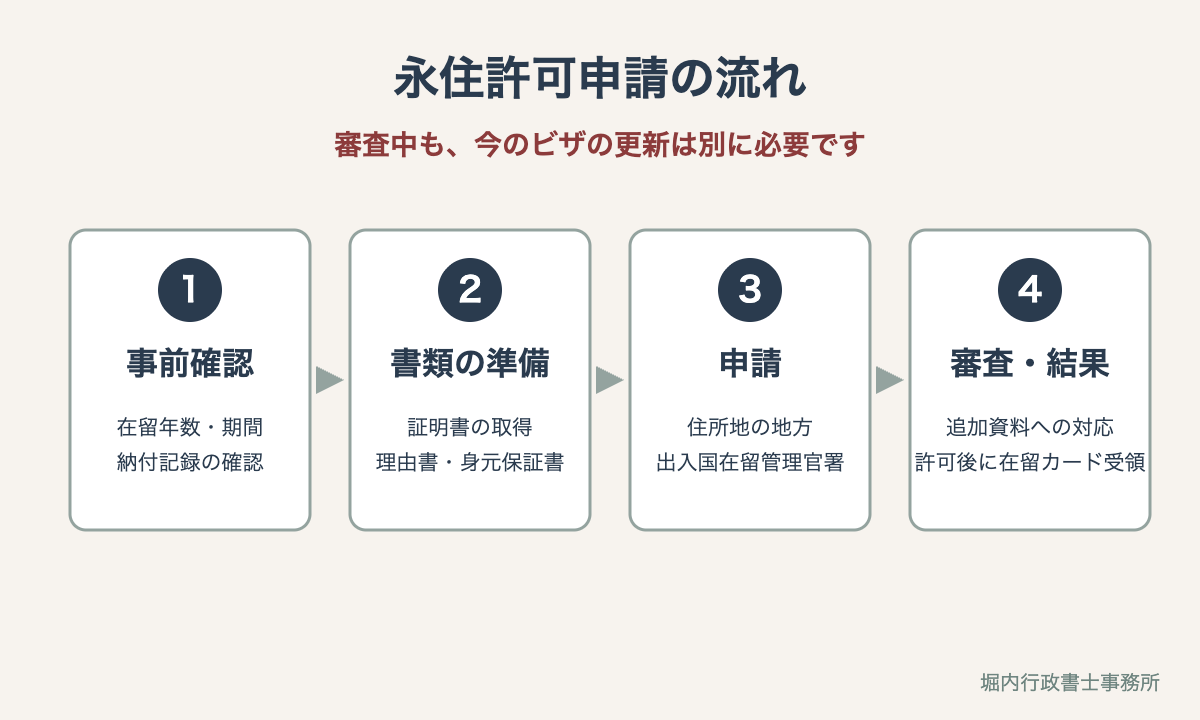
You must renew your current visa even while your permanent residency application is pending.
Unlike applications to change or renew a status of residence, applications for permanent residence do not include a “special grace period” that allows you to remain in the country even after your current period of stay has expired. If the expiration date of your current visa approaches while your application is being processed,Submit a separate application to renew your period of stayYou must do this.
8. When is the best time to apply?
- Individuals with a "3-year" period of stay: Check first to see if you can apply by March 31, 2027
- Spouses of Japanese nationals/permanent residents: the period requirement becomes longer from April 2027, so check the timing
- Those Who Have Missed a Payment: After resolving the issue, apply only after maintaining a "track record with no delays" for a certain period of time.
- Fees: For applications submitted on or after October 1, 2026, the fee is 200,000 yen, payable at the counter or via revenue stamps. For applications received by September 30, 2026, the fee remains at 10,000 yen, as it was before the revision (“How Much Are Visa Renewal and Permanent Residency Fees? Full List After the October 2026 Increase」)
9. Common Reasons for Rejection
Common Reasons for Denial Seen in Practice
- Delinquent resident tax payments or repeated late payments
- Non-enrollment, non-payment and gaps in pension and health insurance
- I can't explain the stability of my income due to my recent job change
- There's no explanation of the household budget even though the number of dependents has increased.
- I've had several traffic violations recently.
- Frequent trips abroad and a weak basis of actual life in Japan
- Discrepancies between documents (address, start date, annual income, company name, etc.)
- The statement of reasons is not linked to the key points of the review
- Slow or Inadequate Response to Requests for Additional Materials
Even if your application is denied, you can reapply. It is important to first check with the immigration office to find out the reason for the denial, and then apply again after demonstrating that you have addressed the issue.
10. How do I write a statement of reasons?
The purpose of a statement of reasons is not to write a lengthy document, but to provide an explanation that summarizes the facts and supporting evidence from the perspectives of conduct, livelihood, and national interest. Do not conceal any issues that arose, and"Facts → Causes → Improvements → Prevention of Recurrence → Current Status"We recommend organizing them in that order. For details on how to write them, see “How to Write a Statement of Reasons for a Permanent Resident Application | Explaining Adverse Circumstances and Examples".
Actual cases handled by our office
A case where the person had many dependents and was concerned about the income threshold, and,Highly Skilled Professional visaEven if that isn't the case, this is an instance where the applicant applied by being "deemed a highly skilled professional" based on a score of 80 points or more.
CASE · Highly Skilled Professional
Living with My Family
Permanent Residency Application for Highly Skilled Professionals
2 years and 1 monthScreening
CASE · Application for Designation as a Highly Skilled Professional
80 points or more ·
Working from Home
6 monthsScreening
The review period varies depending on the content and timing, and we cannot guarantee a specific timeframe.
Client Testimonials
Thank you so much for all your help throughout the process of applying for, being approved for, and receiving my Japanese permanent residency. …You were able to communicate with me in Korean… and you were very approachable from the very beginning, so I felt completely at ease entrusting the process to you. Thanks to your careful and prompt assistance with the complex paperwork, I was able to successfully obtain my permanent residency.
— A long-time resident, Google Maps review
I hired them to help me obtain permanent residency, and even though they asked for additional documents several times, I believe I was able to get it thanks to their calm and methodical preparation. Their Korean is excellent, so it’s no problem at all even if you don’t speak Japanese.
— A long-term resident, Google Maps review (translated from the original Korean)
I felt very reassured by the careful attention given to every detail. Also, the results came back faster than I expected, and the staff continued to provide support right up until I received my residence card, which was a huge help.
— Customers applying for visas (excluding permanent residency), Google Maps reviews
Customer reviews areGoogle MapsWe are reprinting the post as it appeared (with some parts omitted).
Items You Need to Have Ready When Placing an Order
The basic documents listed by the Immigration Bureau (for those residing in Japan under a work visa or family residence status) are as follows. For your initial consultation, the documents you already have on hand will suffice.
- Residence Card and Passport
- Certificates of Residence for All Household Members
- Certificate of Employment (for self-employed individuals, a copy of the tax return, etc.)
- Resident tax assessment and payment certificates (for the past 5 years) and documentation showing that payments were made by the due date
- Documents regarding pension and health insurance payments (for the past two years)
- Documents verifying assets, such as copies of savings passbooks
The required documents vary depending on whether you are a highly specialized professional, applying as a highly skilled professional, a spouse, or a permanent resident, and may also differ based on your individual circumstances. Please consult with us, and we will provide you with a list of documents tailored to your specific situation.
Frequently Asked Questions
For a family of four, how much annual income is needed?
The guidelines do not specify a fixed amount; the standard is an income equal to or greater than the average for Japanese households with the same number of members. Since certain types of income—such as part-time earnings by family members staying with the household—are not included, each household must be assessed individually.
How many years of taxes are checked?
Applicants applying for a work visa must submit proof of payment for resident tax for the past five years and for pension and health insurance for the past two years. For periods during which payments were not made through special withholding (payroll deduction), you must also provide receipts or copies of bank statements showing that the payments were made by the due date.
I had late payments in the past. Can I no longer apply?
That's not the case. If you can explain in your documentation that the issue has been resolved and has not recurred, you can reduce the risk. However, in many cases, it's better to adjust the timing of your application.
Can my family apply with me?
It is common for spouses and children to apply together. However, if there are issues with one family member’s payment history or length of stay, the outcome may differ for that individual alone, so be sure to check each family member’s information separately.
For other questions, see “Japan Permanent Residency Application: 20 Q&As | Frequently Asked Questions".
Related Articles
- Summary of the Revised Permanent Residency Guidelines | Income, Pension and Japanese Language [2026]
- Permanent Residency for Highly Skilled Professionals | Special Rules: 3 Years at 70 Points, 1 Year at 80 Points [2026]
- How to Write a Statement of Reasons for a Permanent Resident Application | Explaining Adverse Circumstances and Examples
summary
Permanent residency is not determined solely by the number of years you have resided in the country.Records showing that taxes, pension contributions, and insurance premiums were paid on time; proof of steady income; and compliance with laws and regulationsThis will be verified through documentation. If you have any concerns, it’s best to address them first; in many cases, the quickest path to success is to wait several months to a year to ensure you’re in a “good standing” before applying.
For details on our firm's services and fees, please see "Visa Application (Permanent Residency)"You can check it here."
We hope this information is helpful, even in a small way, as you prepare your application for permanent residency. If you’re wondering when you’ll be eligible to apply, please feel free to contact us.
[Reference Materials]
- Immigration Services Agency of Japan, “Guidelines on Permanent Residence Permits”
- Japan Immigration Services Agency: "Application for Permanent Residence"
- Japan Immigration Services Agency Leaflet: “Revision of Residence Permit Fees” (PDF)
- Japan Immigration Services Agency: Documents Required for “Application for Permanent Residence 3 (Work Status/Family Stay)”
(Verified November 19, 2026)

ABOUT US
Horiuchi Gyoseishoshi Office

Administrative Scrivener Yukiko Horiuchi
- Member of Shinjuku Branch, Tokyo Gyoseishoshi Association
- Tokyo Immigration and Residency Management Bureau, Application Agency Gyoseishoshi Scrivener
- Member of Foreign Employment Support Organization (FESO)
Access
- 1 minute walk from Higashi-Shinjuku Station on the Tokyo Metro Fukutoshin Line
- 1 minute walk from Higashi-Shinjuku Station on the Toei Oedo Line
- 10-minute walk from Seibu-Shinjuku Station (Seibu Shinjuku Line)
- 10-minute walk from Shin-Okubo Station (JR Yamanote Line)
- 15-minute walk from Shinjuku Station on the JR Yamanote Line
- 15-minute walk from Okubo Station (JR Chuo-Sobu Line)
If you have any questions regarding residency status (visas), permanent residency, naturalization, or starting a business, please feel free to contact us.